Sun fires 10 solar flares in 24 hours, aurora hopes rise
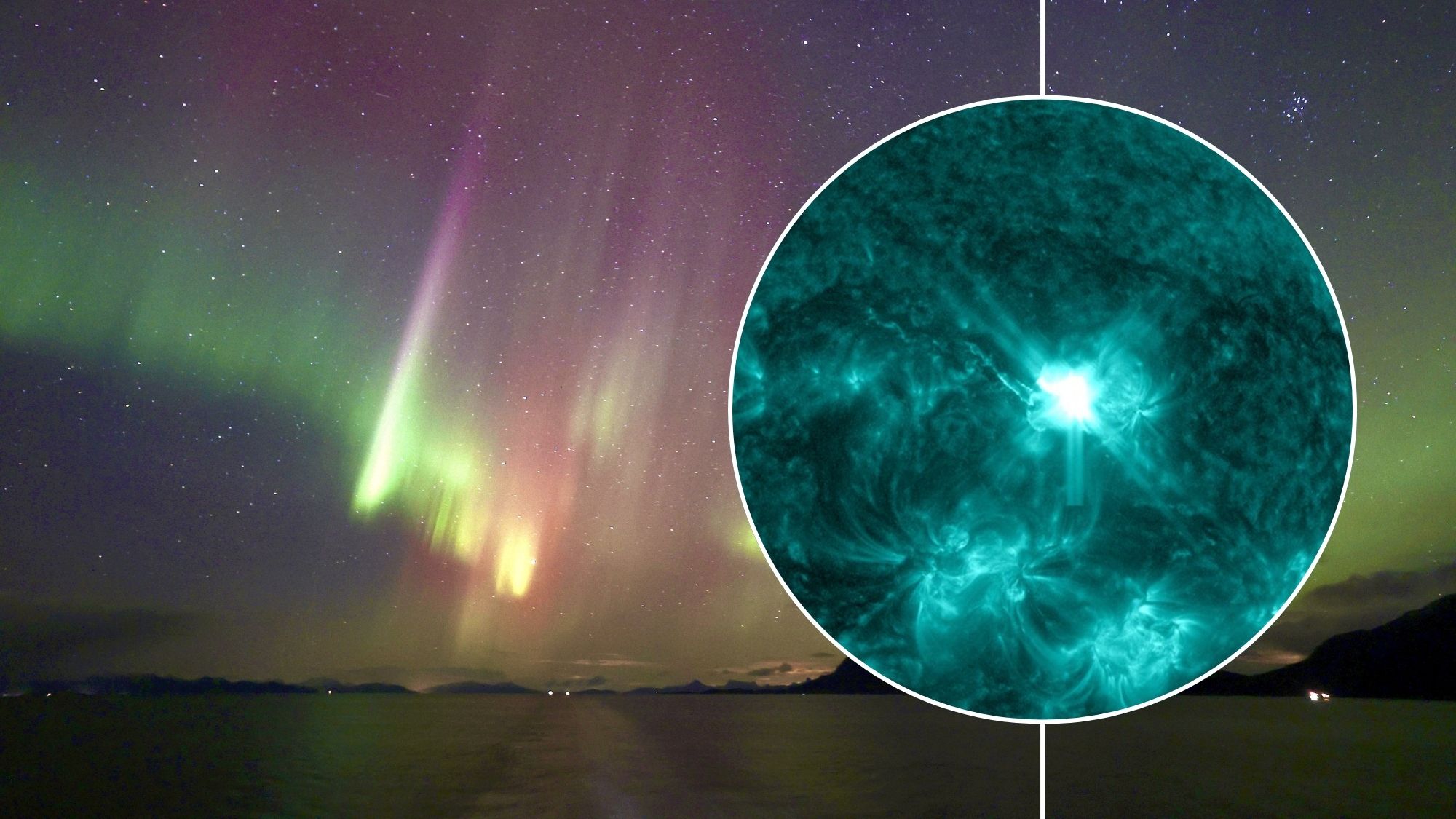
The sun fired 10 M-class solar flares within 24 hours after a powerful X1.1 solar flare on June 30, 2026, sending multiple Earth-bound coronal mass ejections toward our planet. NOAA forecasters expect G1 to G2 geomagnetic storm conditions around the July 4 weekend, raising hopes that northern lights could appear across parts of the northern United States.
If you have been waiting for a headline-grabbing sky show, this solar flare barrage delivers one without a ticket price. Space weather forecasters say several partially Earth-directed CMEs are still being modeled, but the timing lines up with one of the busiest stargazing weekends on the U.S. calendar.
Key Takeaways
- An X1.1 solar flare peaked at 4:50 p.m. ET on June 30 from sunspot region AR4479, followed by 10 M-class flares in the next 24 hours.
- NOAA issued a G2 moderate geomagnetic storm watch for July 3, with northern lights possibly visible as far south as New York and Idaho under clear, dark skies.
- The X1.1 eruption triggered R3 strong radio blackouts across the daylight side of Earth, mainly affecting high-frequency users in North America.
- An earlier M5.8 flare prompted a brief S1 minor solar radiation storm warning that NOAA canceled within 36 minutes when conditions eased.
- For creators tracking wealth hacks and passive income ideas, rare aurora events can fuel zero-cost photo and video content when geomagnetic storms push lights south.
What caused the sun to fire 10 solar flares in 24 hours?
The outburst began with the most intense class of eruption our star can produce. On June 30, active region AR4479 near the center of the visible solar disk unleashed an X1.1 solar flare at 20:50 UTC, according to NASA Science. NASA's Solar Dynamics Observatory captured the bright flash in extreme ultraviolet light.
X-class flares sit at the top of the classification scale; the number indicates relative strength within that tier. NASA notes that flares and solar eruptions can affect radio communications, electric power grids, navigation signals, spacecraft, and astronauts.
The June 30 X1.1 event did not travel alone. Earlier that day, active region AR4475 on the sun's west limb produced an M5.8 flare at 12:57 UTC. The Space Weather Prediction Center issued an S1 minor solar radiation storm warning at 16:00 UTC after that eruption, then canceled it at 16:36 UTC when particle levels no longer justified the alert, The Watchers reported.
Hours later, the X1.1 flare arrived with Type II and Type IV radio emissions and extreme ultraviolet dimming consistent with a coronal mass ejection. Coronagraph imagery showed a full-halo CME first visible at 21:45 UTC, with a Type II shock speed estimated at roughly 1,496 kilometers per second. A halo profile, expanding in all directions as seen from Earth, is a strong sign that solar material may reach our magnetic field.
After that anchor eruption, Space.com reported the sun continued firing off 10 M-class solar flares within 24 hours. Several were accompanied by CMEs that appear at least partially Earth-directed. Solar physicist Tamitha Skov described the pattern as a "machine-gun sun" on social media, noting more than five solar storms en route with at least three offering good aurora chances, though rapid-fire eruptions have made modeling difficult.
Will the northern lights be visible on July 4 weekend?
That is the question aurora chasers, holiday travelers, and late-night photographers are asking first, and forecasters say the odds are real but not guaranteed. NOAA's Space Weather Prediction Center issued a G2 moderate geomagnetic storm watch for July 3 after further analysis confirmed an Earth-directed component from the June 30 CME.
The agency's latest three-day forecast called for moderate G2 geomagnetic storm conditions around 8 to 11 p.m. EDT on July 2, equivalent to 0000 to 0300 GMT on July 3, with minor G1 storm conditions for much of July 3. G2 activity can push auroras farther south than usual. NOAA's storm scales suggest displays may become visible across parts of the northern United States, including New York and Idaho, provided skies stay dark and clear.
Visibility still depends on factors forecasters cannot lock in days ahead. How incoming CMEs merge, how many actually strike Earth, and especially the north-south orientation of their embedded magnetic fields all shape the final show. A southward-pointing field can couple more efficiently with Earth's magnetosphere, producing brighter, wider auroras.
Short northern hemisphere nights and lingering summer twilight could make faint glows harder to spot with the naked eye. Space.com advises keeping cameras charged and aurora alerts switched on. With multiple CMEs in transit, natural fireworks could complement Independence Day celebrations for observers in the right latitude band.
How could a solar flare affect radio and power on Earth?
Solar flares and CMEs hit Earth on different timelines. Because flare energy travels at the speed of light, the X1.1 burst reached Earth in just over eight minutes and triggered strong R3 radio blackouts across the daylight hemisphere. The Watchers reported the flare had potential to disrupt wide-area high-frequency communications for about an hour, with the strongest effects near the subsolar point. Space.com said North American HF users saw temporary signal degradation or brief outages at peak intensity.
CMEs are slower, magnetized plasma clouds that take days to arrive. Their geomagnetic impacts can stress power grids and satellite operators, though this event's public focus has centered on storm watches rather than widespread grid emergencies. NOAA remains the U.S. government's official source for space weather forecasts, watches, warnings, and alerts at spaceweather.gov.
Active regions AR4475, AR4478, and AR4479 still carry a slight chance of additional X-class flares, according to SWPC outlooks cited by monitoring outlets. That means the machine-gun pattern could continue, adding fresh CME candidates to an already crowded queue.
Can aurora chasers turn a solar flare into passive income?
Space weather is not a paycheck, but major geomagnetic storms create unusually strong conditions for low-cost content creation. When G2 storms shove auroras into mid-latitude states, social feeds fill with timelapse clips, still frames, and live streams that can attract ad revenue, licensing interest, or print sales without paid travel to the Arctic Circle.
The playbook is simple and source-aligned: monitor NOAA alerts, shoot during the darkest window you can find, and publish quickly while search interest spikes. None of that requires inventing demand. Space.com itself notes observers should prepare gear now because multiple CMEs may keep skies active through the July 4 weekend.
Pair this event with broader strategies in our Wealth Hacks & Passive Income archive, from digital products to seasonal side hustles, and you have a timely example of how free natural spectacles can become monetizable assets when you show up prepared. The sun did the expensive part; your job is capture, context, and consistency.
Keep expectations grounded. Aurora displays are never certain, and copyright-free hype will not replace solid technique. Check local weather, respect dark-sky etiquette, and treat SWPC data as the authority. If the lights appear, you will have documented a rare convergence of solar cycle fireworks and a national holiday weekend. If they fade, you still built an audience that trusts you to explain what the sun did, and why it mattered, in plain English.