Mysterious 10-sided cloud found at Saturn south pole
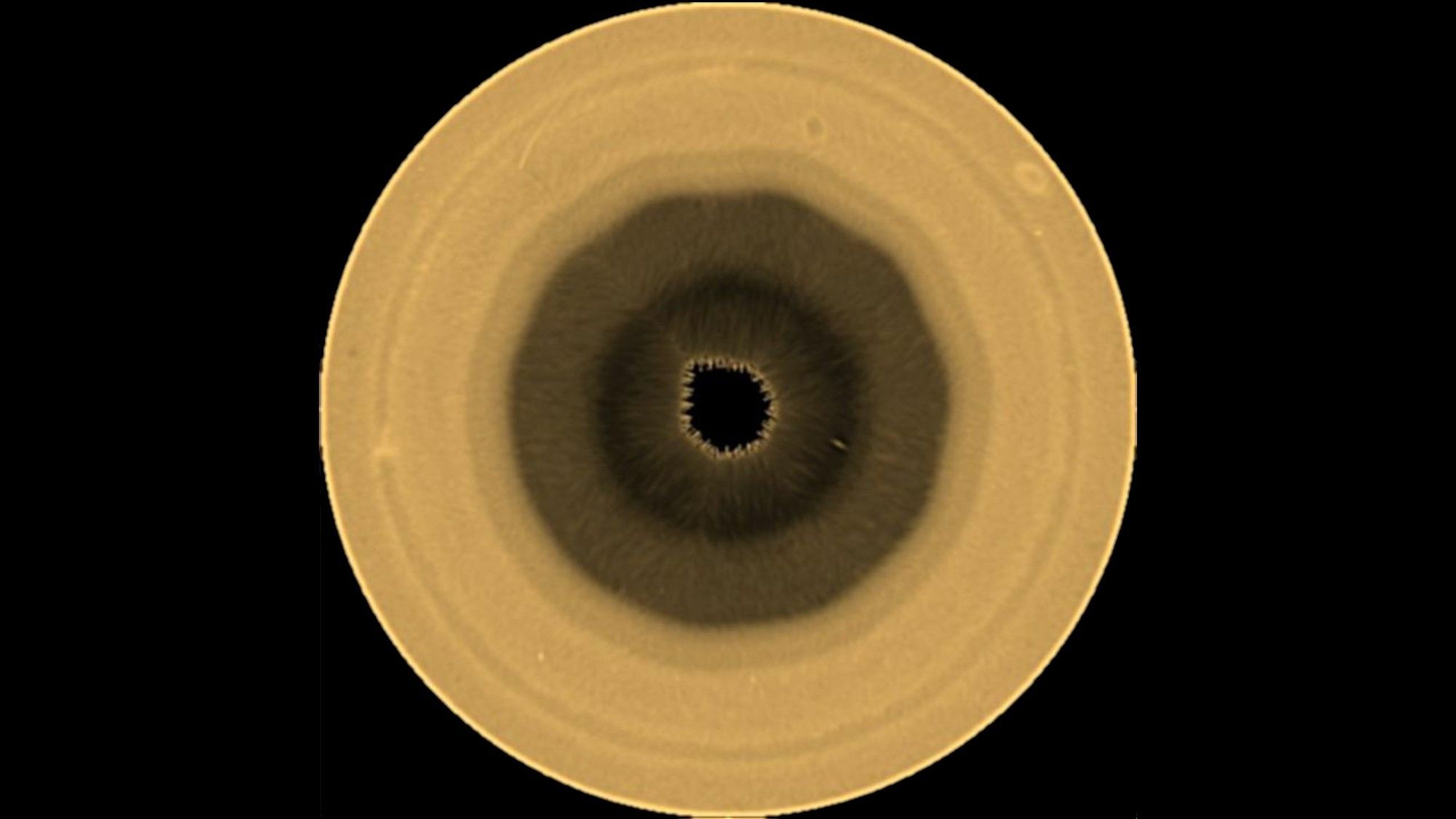
Astronomers using NASA's Hubble Space Telescope have spotted a giant 10-sided cloud pattern swirling over Saturn's south pole — a newly reported "decagon" larger than the planet's famous northern hexagon. The structure, detailed in Science Advances, suggests Saturn's polygonal jet streams are not unique to one pole.
Key Takeaways
- Hubble images from 2023 revealed a huge 10-sided wave pattern in icy ammonia clouds over the Saturn south pole.
- The decagon spans about 104,250 miles (167,820 kilometers), dwarfing the north-pole hexagon long studied since Voyager.
- Researchers say it may have formed between 2017 and 2023 while Saturn's southern hemisphere was tilted away from Earth.
- Unlike the nearly stationary hexagon, the decagon migrates eastward at roughly 6 mph (10 kph) and may still be evolving.
What did scientists find at the Saturn south pole?
A Spanish-led team reported an enormous spinning decagon in Saturn's southern jet stream after reviewing recent Hubble images. Lead author Agustin Sanchez-Lavega of the University of the Basque Country said the feature came as a surprise after years of hunting for a southern polygon.
Saturn's axial tilt hid the southern hemisphere from Earth-based viewing from about 2012 to 2023. Hubble's 2023 views finally showed the pattern. Earlier checks had found no southern counterpart to the north's six-sided storm.
The findings appeared Sept. 2 in the journal Science Advances, according to Space.com and AP News coverage of the study.
How big is this 10-sided Saturn cloud, and how does it work?
Each of the decagon's 10 sides measures about 10,425 miles (16,782 km). The full figure is roughly five times as wide as the northern hexagon, which spans about 20,000 miles (32,000 km) and was first identified in 1988 from Voyager data.
Computer simulations of shallow-water currents suggest a meandering wave trapped by a curving atmospheric jet shaped the pattern. The University of Leicester's Leigh Fletcher helped measure its winds with the European Southern Observatory's Very Large Telescope in Chile.
Sanchez-Lavega said the structure takes about 800 days to complete a rotation about Saturn. Darkness varies across its sides and points, unlike the hexagon's more uniform look for decades — a clue it may still be changing.
Why does the Saturn south pole decagon matter?
Only Saturn is known to churn out polygon-shaped jet-stream waves like these, even though other planets with atmospheres spawn wave disturbances. Comparing the north hexagon with this southern decagon gives scientists a rare dual laboratory for gas-giant weather.
"This is a very unusual atmospheric phenomenon that is helping us to advance our understanding of meteorology in general," Sanchez-Lavega told Space.com. He added that the hexagon is no longer seen as a one-of-a-kind feature.
It remains unclear whether the decagon will endure as long as the hexagon, visible for more than 40 years — longer than one Saturnian year of about 30 Earth years. Solar radiation at about 60 degrees south will peak around 2032, which may stabilize or disrupt the pattern.
For now, Sanchez-Lavega confirmed the decagon is still there. Fans of bizarre news have another cosmic oddity to watch as Hubble and ground telescopes keep tracking Saturn's surprising south.