Regular training erases parts of muscle aging signature
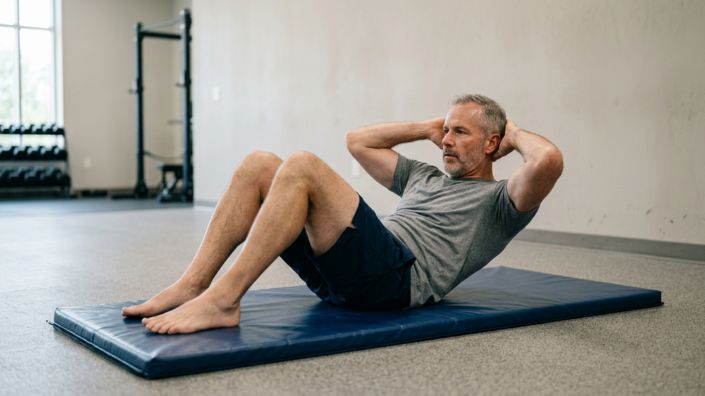
A Nature Aging study finds that regular training erases parts of the molecular muscle aging signature that daily step counts alone do not reverse. In trained older adults, more than half of age-related gene-expression shifts were absent—especially in energy and mitochondrial pathways—while other aging marks looked exercise-proof.
Key Takeaways
- Structured training, not everyday activity alone, was linked to a more youthful muscle molecular profile in older adults.
- About 56–57% of age-related gene-expression changes were missing in trained older muscles, mainly in mitochondrial and energy pathways.
- After a one-hour bike challenge, trained older adults’ gene responses most closely matched those of young adults.
- Other aging-related changes in signaling, tissue maintenance, and regeneration looked largely unaffected by exercise.
- The findings show association, not proof that training caused the younger-looking molecular pattern.
Researchers from Amsterdam UMC and Maastricht University compared young adults with older adults who were either normally active, highly trained, or physically impaired. The work, published in Nature Aging and covered by Lifespan.io, asked a practical longevity question: does planned exercise change muscle aging beyond simply staying on your feet?
For more on aging biology and interventions, see our Longevity & Biohacking coverage.
Does regular training erase parts of muscle aging that steps miss?
The study enrolled 47 people: 11 young adults (average age 23), 16 trained older adults (average age 68), 15 normally active older adults, and five physically impaired older adults. “Trained” meant at least three planned one-hour exercise sessions per week for more than a year. Impairment meant failing the Short Physical Performance Battery of balance, walking speed, and chair stands.
Daily movement was closely matched between young and normally active older adults—about 10,200 versus 9,600 steps—and higher-intensity time was broadly similar. Even so, the groups diverged across gene expression, metabolites, and lipid measures. Older muscles showed weaker expression of genes tied to mitochondrial respiration and energy production, plus lower NAD+ pathway metabolites needed for energy metabolism and cellular stress responses.
In trained older adults, more than half of those age-related expression shifts were absent: 56% of upregulated and 57% of downregulated genes. The protective pattern was strongest for mitochondrial and energy-metabolism genes—the clearest molecular hallmarks of muscle aging in this cohort. Genes tied to synaptic or cell-signaling processes, tissue maintenance, and regeneration often stayed age-shifted, which the authors frame as “preventable” versus “unavoidable” change.
How did trained older muscles respond to a hard workout?
Thigh-muscle biopsies were taken at rest and right after one hour of cycling. The transcriptional response to that acute bout differed with age, but the gap was smallest in trained older adults, whose pattern most resembled young people. The impaired group diverged the most.
Shared post-exercise shifts in young and normally active older adults included rises in inflammation- and stress-related genes such as IL6, IL1B, and TNF. That temporary stress-and-repair signature was most pronounced in trained adults. The authors interpret this as healthier older muscle mounting a useful acute response—while stressing the result is correlational, not causal.
Why is this not a miracle anti-aging fix?
Exercise intensity was set at 50% of each person’s maximum, so trained adults may have done more absolute work than even the young group—a confounder the authors note. Regular hard training could also condition a stronger acute response without proving that response keeps muscles young.
Bottom line for readers chasing longevity habits: clocking steps helps, but planned, repeated training appears linked to erasing roughly half of the molecular aging signature in muscle—especially energy systems—while geroscience still needs tools for the half that looks exercise-proof.