Partial reprogrammings outcome depends on cell type
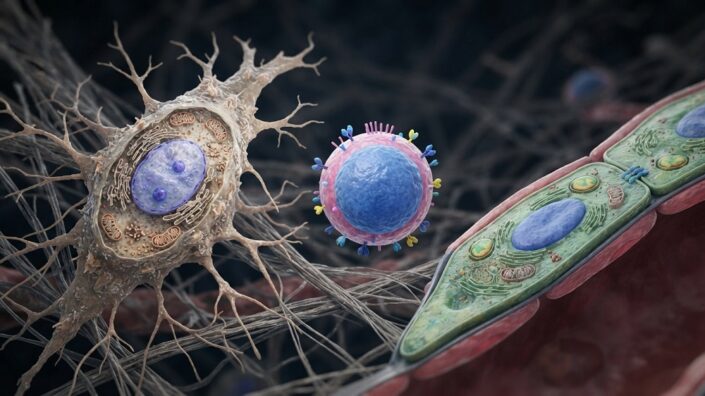
A Gladstone Institutes preprint shows that partial reprogrammings outcome depends heavily on which human cells get transient OSKM exposure. Fibroblasts, T cells, and endothelial cells diverged on epigenetic age, identity recovery, and growth—proving a younger clock reading does not always mean better function after treatment ends.
Key Takeaways
- A Gladstone team that included Shinya Yamanaka tested transient OSKM exposure in fibroblasts, cytotoxic T cells, and aortic endothelial cells from donors aged 48 to 63.
- Cells were grouped into shallow (Gr1), intermediate (Gr2), and near-pluripotent (Gr3) states using identity and reprogramming markers—not exposure time alone.
- Younger epigenetic ages and better function did not always move together after withdrawal of the factors.
- Endothelial cells recovered well with age reduction; deep fibroblast states kept lasting growth deficits despite lower clock readings.
- The work implies organ- or body-wide rejuvenation may need cell-type-specific protocols.
What did the partial reprogramming study actually test?
Full reprogramming with the Yamanaka factors OCT4, SOX2, KLF4, and c-MYC can push somatic cells toward pluripotency, but that process strips normal cell identity—making it unsafe as a whole-body therapy. Partial reprogramming, usually a brief OSKM pulse, has been pitched as a way to rejuvenate cells without full dedifferentiation.
According to coverage of the preprint on Lifespan.io, researchers at Gladstone Institutes put that assumption under a harder microscope. They tracked how three human lineages responded when OSKM was turned on, then withdrawn, and asked whether a younger epigenetic profile truly tracked with recovered or improved function.
OSKM was withdrawn on day 7 for fibroblasts and endothelial cells, and on day 5 for T cells, which moved into advanced states faster. Endothelial cells rarely reached Gr3. Readers following aging science on BlasterPost’s Longevity & Biohacking hub will recognize why that design matters: “dose” is not the same as reprogramming depth.
Do younger epigenetic ages always mean better cell function?
No. Fibroblasts showed progressively lower estimated ages in deeper states, yet past-Gr1 exposure left lasting growth problems. Gr3 fibroblasts still grew poorly even 20 weeks later, while keeping lower clock readings. T cells told a different story: Gr1 cells expanded better than controls and showed stronger immune-linked activity even after epigenetic age returned toward untreated levels around day 26. Gr3 T cells failed to recover and were lost after day 11.
Endothelial cells were the clearest win. They combined epigenetic age reduction with improved performance, recovered quickly from Gr1 and Gr2, and proliferated well. Gene-expression and chromatin maps also diverged by lineage, with the regulator TOX among the few shared helpers of efficient reprogramming—though its associated programs still differed by cell type.
Why does this matter for longevity therapies?
Partial reprogramming has drawn huge capital, including multi-billion-dollar bets on cellular rejuvenation. If outcomes split this sharply by cell type, treating whole organs—or the whole body—may need tailored schedules, depths, and factor recipes rather than one universal OSKM pulse.
The study also reframes a basic definition: if some cells regain function while clocks rebound, and others look epigenetically younger while performing worse, what should count as rejuvenation? Animal work has already shown functional gains from partial reprogramming, and related clinical efforts sometimes use OSK rather than OSKM on different schedules. Those recipe differences could matter as much as the biology itself.