New monkey species with orange lips found in DRC forest
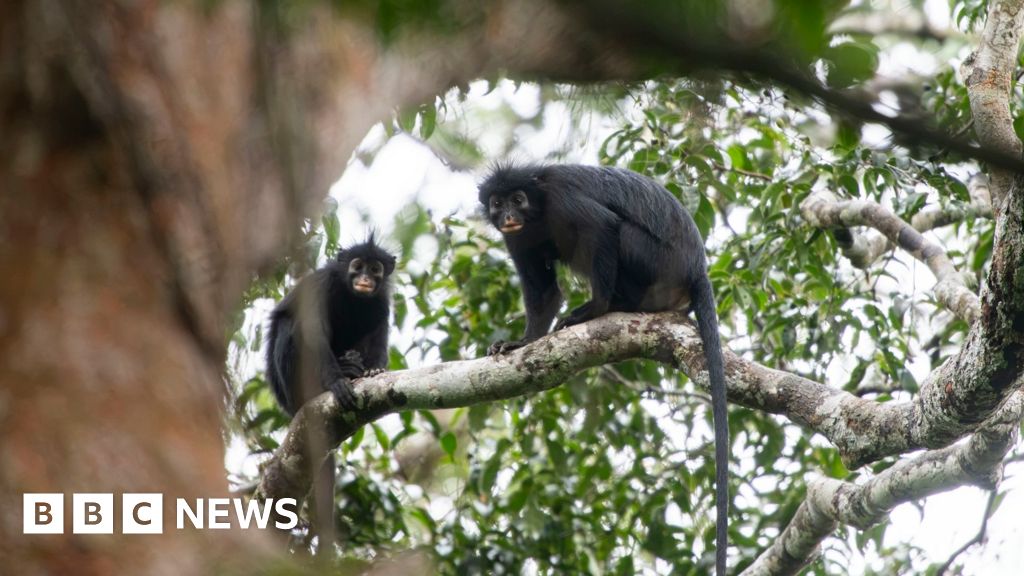
Scientists have confirmed a new monkey species in the Democratic Republic of Congo: Colobus congoensis, known locally as Likweli. The black-furred colobus has striking pinkish-orange lips and lives high in Lomami National Park's canopy. Researchers say the shy primate is rare, often heard roaring before it is seen, and may need stronger protection as hunting continues.
Key Takeaways
- Researchers formally described a new monkey species, Colobus congoensis (Likweli), after genetic and field studies published in PLoS One.
- The animal's pinkish-orange lips and black face set it apart; it is only the fifth African monkey species found in 75 years.
- Likweli hides in dense canopy in Lomami National Park and was first photographed in 2008, then studied after a later sighting.
- Scientists hope official recognition will help protect the rare, hunted colobus and its restricted forest habitat.
According to the BBC, conservationists in Lomami National Park, in the central east of the DRC, first reported the unusual-looking monkey in 2008 with a single blurry photo. After another sighting a decade later, an international team from the DRC, the United States and Germany set out to confirm what they were seeing.
Junior Amboko, a PhD student at Florida Atlantic University who helped lead the search with audio recordings, photography and genetic work, told the BBC it was an "amazing feeling" to face an animal so few people knew existed. Local communities call it Likweli, but Amboko said the monkeys are "kind of shy" and tend to stay high in the trees.
What makes this new monkey species stand out?
Likweli belongs to the larger group of colobus monkeys—African primates that do not have thumbs. Alongside its black fur and black face, it shows a conspicuous pinkish-to-orange mouth patch. Phys.org reporting on the PLoS One study also notes bare gray cheek skin that contrasts with darker skin around the eyes, plus a white fur patch near the anus, giving a mask-like look.
The Washington Post describes Likweli as weighing about 15 pounds—similar to a small dog—and spanning roughly four feet from nose to tip of tail. Amboko and colleagues recorded a distinctive, resonant "roaring" call. "You often hear them, but don't see them," he said.
Prof. Kate Detwiler of Florida Atlantic University told the BBC these canopy herbivores are a critical part of the ecosystem and likely help with seed processing and germination. She speculated the bright facial markings could help animals signal mates or recognize one another.
Where was the new monkey species found, and how rare is it?
Field work places Likweli in closed-canopy forest inside and around Lomami National Park. Phys.org reports surveys showing the species occupies at least about 1,700 square kilometers between the Lomami and Lilo rivers—far smaller than the ranges of many other colobus monkeys. Its closest living relative, Colobus satanas, lives more than 1,200 kilometers away.
Amboko's team interviewed residents of 52 nearby villages; people in only eight said they had ever seen the monkeys. That scarcity, plus hunting for meat, is why researchers want Colobus congoensis officially protected now that it is classified as distinct.
Why does confirming Likweli matter now?
Formal description is more than a taxonomic footnote: it is how science documents genetic distinctiveness and builds the case for conservation. The team still plans population surveys and behavior studies, and they stress many questions remain about this secretive primate.
Discoveries like this also show how much rainforest biodiversity remains poorly mapped—an angle that belongs alongside other breakthroughs tracked in Future Tech & AI Wonders, where science headlines meet the tools used to study a changing planet.
As human populations expand near Congo Basin forests, researchers say safeguarding Lomami's canopy—and the orange-lipped Likweli that hides there—should be a conservation priority.