Azerbaijan and Uzbekistan deepen trade and Trans-Caspian ties
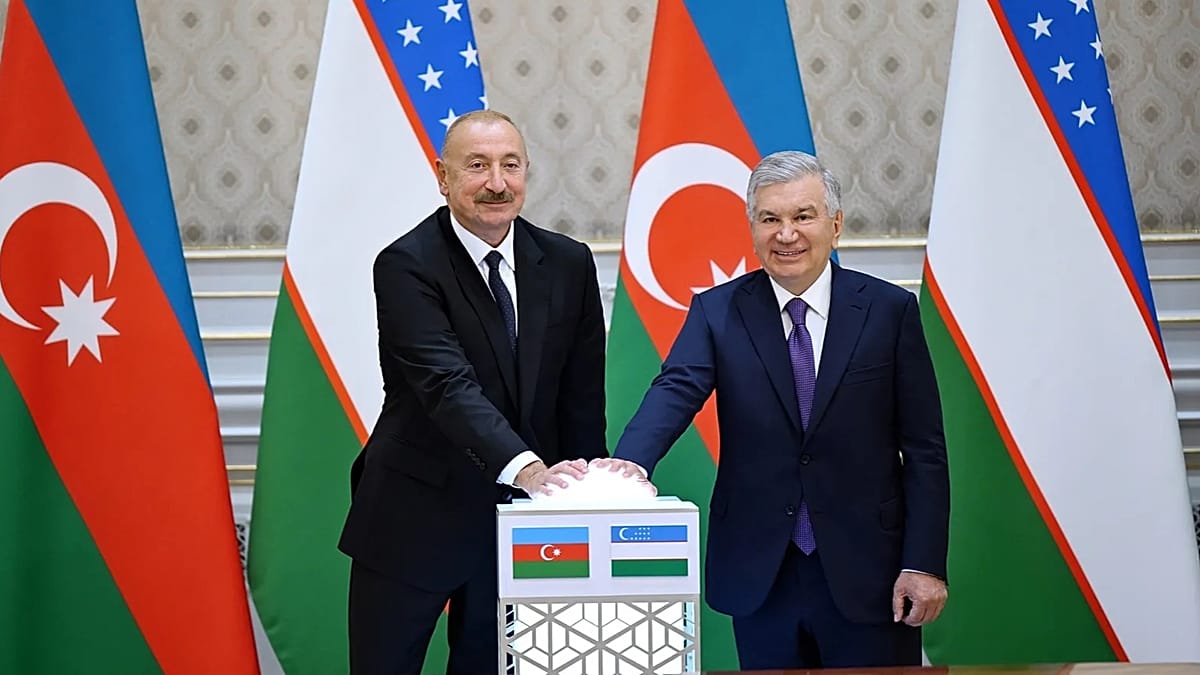
On August 23, 2026, Azerbaijan and Uzbekistan signed a Treaty on Eternal Friendship in Tashkent and agreed to raise bilateral trade to $1 billion by 2030, while Presidents Ilham Aliyev and Shavkat Mirziyoyev pledged stronger Trans-Caspian freight links through the Middle Corridor and launched projects spanning banking, energy, tourism and urban development. The two-day state visit built on a 2024 Treaty on Allied Relations and the Supreme Interstate Council established in 2023.
Key Takeaways
- Azerbaijan and Uzbekistan signed a Treaty on Eternal Friendship and set a $1bn trade target for 2030.
- Transit freight between the two countries reached 1.4 million tonnes in 2025, with volumes up 12.2% in the first half of 2026.
- Leaders agreed to strengthen Middle Corridor logistics and explore a joint Caspian Sea fleet.
- President Aliyev toured New Tashkent, a megaproject integrating digital technologies and trigeneration systems.
- The countries will jointly host the 2027 FIFA U-20 World Cup under a "Two countries – one championship" programme.
Why are Azerbaijan and Uzbekistan deepening ties now?
President Mirziyoyev described Azerbaijan as "our reliable ally, strategic partner and brotherly state" after one-on-one talks and the third Supreme Interstate Council meeting. Trade reached $795 million in 2025, more than three times the previous year's level. Between January and May 2026, trade hit $144 million, up 33% year-on-year.
The Azerbaijan-Uzbekistan Investment Company, created in 2023 with $500 million in capital, is financing projects across both countries. Leaders inaugurated Azerbaijani-backed ventures in banking, construction, education, fuel retail, tourism, housing, mining and agriculture—including a gypsum plant, two STEAM schools, five planned SOCAR filling stations and a silver-ore processing facility.
How will Trans-Caspian links reshape regional trade?
After the talks, President Aliyev described Central Asia and Azerbaijan as "a single geopolitical and geo-economic region." Both leaders agreed to strengthen connectivity through the Middle Corridor, focusing on logistics infrastructure and freight traffic along the trans-Caspian network linking Central Asia with the South Caucasus and Europe.
Transit freight between Uzbekistan and Azerbaijan reached 1.4 million tonnes in 2025. In the first half of 2026, volumes rose 12.2% year-on-year to 675,000 tonnes. President Mirziyoyev also announced plans to step up work on creating a joint fleet on the Caspian Sea.
The European Union backs the Trans-Caspian network through its Global Gateway strategy, aiming to connect Europe and Central Asia in 15 days or less. Azerbaijan, Kazakhstan and Uzbekistan are also developing a green-energy corridor to connect power systems and explore transmitting renewable electricity across the Caspian. For more on how digital systems are reshaping such corridors, see our Future Tech & AI Wonders coverage.
What did President Aliyev see at New Tashkent?
On August 23, President Aliyev familiarized himself with Uzbekistan's largest urban development project—"New Tashkent." The model integrates the economy, investment policy, transport, education, ecology and digital technologies within a single space. Upon full completion, more than 260,000 new jobs are expected, with more than 10,000 workers currently employed at construction sites.
One key innovative solution is trigeneration technology, through which electricity generation, heating and cooling are managed within a unified technological chain. The leaders also inaugurated the Nizami National Pedagogical University campus—a 40-hectare complex for 20,000 students—and launched work on a four-hectare Azerbaijan Park, mirroring an Uzbekistan Park planned in Baku. Full details are available via Euronews.
What other agreements were signed?
The two sides signed agreements on pensions, culture and tourism, cooperation between foreign and justice ministries, and city-to-city partnerships pairing Urgench with Khankendi and Nakhchivan, and Bukhara with Lachin. Azerbaijan's state-owned ABB is negotiating acquisition of a 51% stake in Uzbekistan's Davr Bank—a deal exceeding $100 million, according to S&P Global.
President Aliyev said bilateral oil and gas exploration projects were nearing their final stage, with production-well drilling potentially starting next year if exploration results are positive. The countries will jointly host the 2027 FIFA U-20 World Cup under a programme dubbed "Two countries – one championship."